The RB1 intake manifold (plenum) as most of you know is a common swap for the CR-Z. Over the years, I have seen many different explanations and interpretations of what the manifold is, how it works and the resultant engine performance. The intent of this post is to describe the plenum and the design goals as I understand them.
The RB1 plenum is identical to the OEM CR-Z plenum except for the addition of a chamber placed above the runners and joined to the main plenum via a small tube. This chamber serves as a resonant tank which provides a form of dynamic charging which helps to force more air into the cylinder. It does this in the following way:
1: Consider the engine starting on the intake stroke of cylinder 1. Air rushes into the cylinder (out of the plenum and through the runner) at a considerable speed for the distance it is covering(10.9cm^2 port area flowing at 90% volumetric efficiency into a 374.25cc cylinder at 6000 rpm is ~15.5m/s (~34.7mph) mean velocity). Based on the length of the runners in the plenum and the aluminum casting (combined ~355mm), the air only spends about 20ms traveling into the cylinder head at WOT and 6000rpm.
2: The intake valve(s) quickly close(s) as the compression stroke begins. When this happens, there is a pressure wave reflected off the face of the valve(s) from the momentum of the intake charge. The momentum of this charge depends on the mass flow and velocity of the charge.
3: It takes time for this pressure wave to reflect back to the main volume of the plenum. When it reaches the plenum, it causes a small increase in pressure in the plenum which is then reflected back into the intake runners (not just the runner the pressure wave originated from) which again takes time to travel.
4: Once this second reflection takes place, there is a pressure wave traveling down the intake runners and toward the valves. If this reflection is timed correctly, the valve(s) will open just in time to let that pressure wave propagate into the cylinder, thus increasing the mass flow into the cylinder from the greater pressure differential between the intake tract and the cylinder. This allows additional fuel to be added to compensate for the additional mass flow.
NOTE: This is a delicate process, meaning the length, cross section and plenum volume all contribute to dynamic charging.
Because this effect is dependent on the mass flow (and in turn momentum) to produce the first reflection, having both intake valves open will provide a stronger pressure wave than a single intake valve. This makes any resonant effects more pronounced. Consequently, with the LEA1 valvetrain, the dynamic charging effects are very small below VTEC speeds (2300-3600rpm on the stock tune). Having a higher lift and duration cam as the L15A7 does when in VTEC, further increases the mass flow into the cylinders and produces stronger pressure waves back into the plenum.
More specifics can be found directly from Honda in the press release for the 2009 Fit: https://hondanews.com/en-US/honda-automobiles/releases/release-8783f16fabeddc4e7516bd004c34bc90-2009-honda-fit-overview
Here is an excerpt from that article:
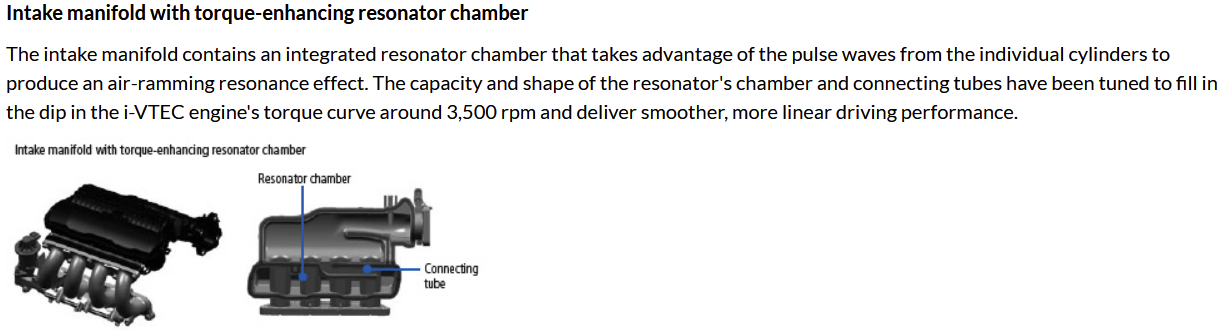
Note that Honda tuned this plenum to compensate for the torque dip that naturally occurs with VTEC crossover. In the L15A7, this window is from 3500-5300rpm. So, not only is the effect from dynamic charging smaller with the LEA1 valvetrain (even when in VTEC), but is is also attempting to fill in a torque dip that is at the upper end of the VTEC window. This is not necessarily a bad thing in terms of VTEC engagement. If you engaged VTEC earlier than 3500rpm on the LEA1 and had this manifold, there would be a small boost at ~3500rpm on top of the earlier gain from adding the second intake valve.
I suspect Honda did not include this manifold on the CR-Z from the factory for two reasons. The first being cost and the second being that the main benefit being a drivability improvement for VTEC crossover, which does not take place with the LEA1 as it does not have a different cam profile it switches to, it simply opens another valve.
Typical torque loss from VTEC crossover is <5lbft (6.8Nm) (or in terms of power, about 3hp (2.5kw) at 3500rpm). Because this change in torque from the resonant effects is relatively small, there is no need to tune the ECU on the CR-Z to compensate for the additional fuel. Assuming your MAF is calibrated correctly for the air intake you are using, the short term trim will be more than capable of adjusting for the fueling requirements.
Some of the threads, tests and comments I have seen posted about claim that peak power is enhanced and midrange is sacrificed. This is the exact opposite effect of the design Honda implemented. Midrange is only improved by this plenum, either subtly in the case of regular driving with the LEA1, or more noticeably with WOT and the L15A7. Peak power is relatively unaffected due to the next harmonic for the plenum occurring at ~7000 rpm. Having additional plenum volume does not hurt flow at any engine speed, runner cross section will primarily affect that.
Leave a Reply